
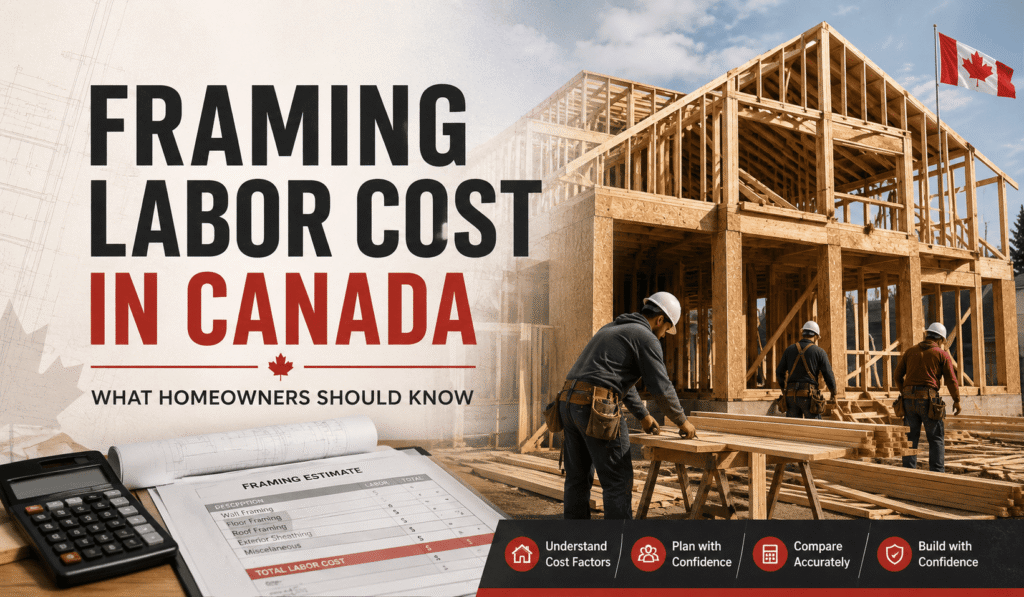
Framing labor cost is one of the most important expenses to understand when planning a new home, addition, garage, basement development, or structural renovation but it usually ranges ranges from $4 to $10 per square foot. The frame gives a building its shape, strength, room layout, roof structure, window openings, and load-bearing support. Because this stage affects almost every trade that follows, hiring experienced framing contractors is not only about price. It is about accuracy, safety, timelines, and long-term structural reliability.
In Canada, framing labor cost can vary widely depending on the size of the project, home design, material type, regional labour market, and the complexity of the structure. Basic framing labour is often estimated by the square foot, but a proper quote should always be based on drawings, site conditions, roof design, and the full scope of work.
For homeowners in Calgary, Alberta, and other Canadian markets, the right framing estimate should not be judged by the lowest number alone. A proper quote should clearly explain the scope of work, labour included, material responsibility, timeline, structural details, and any items that may create additional cost.
What Is Included in Framing Labor Cost?
Framing labor cost usually covers the hands-on work required to build the structural skeleton of the home. This can include:
- Installing sill plates and layout lines
- Framing floor systems and joists
- Building exterior and interior walls
- Installing beams, headers, posts, and load-bearing supports
- Framing window and door rough openings
- Installing roof trusses or rafters
- Wall and roof sheathing
- Bracing, blocking, backing, and structural connections
- Coordination with drawings, site measurements, and inspections
In many cases, framing labour does not include the full cost of lumber, engineered beams, trusses, hardware, crane service, permits, roofing, windows, insulation, drywall, plumbing, electrical, or HVAC work. Homeowners should always confirm whether a quote is labour-only or labour and material combined.
Main Factors That Affect Framing Labor Cost
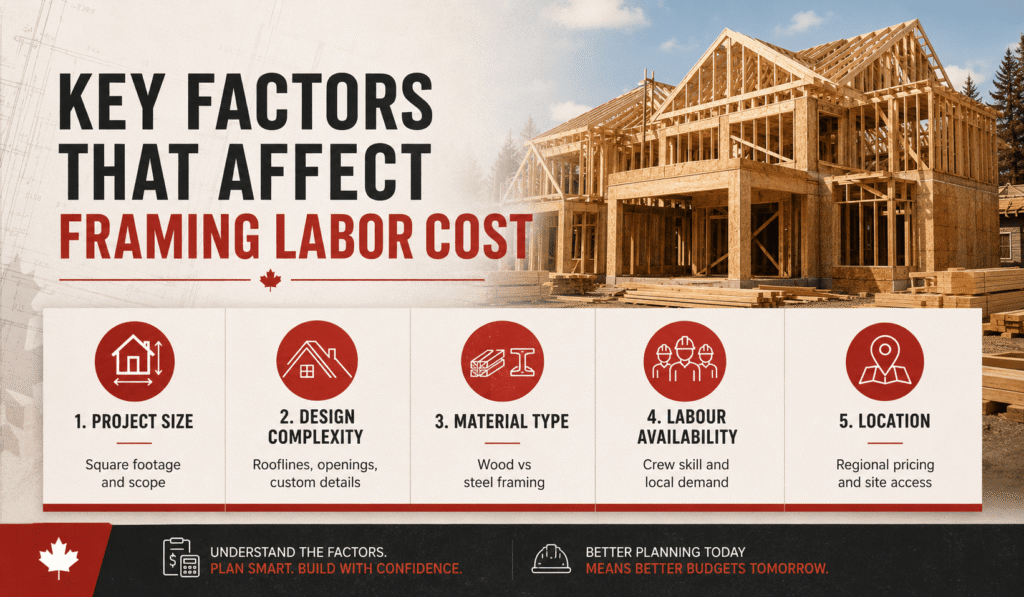
1. Project Size and Square Footage
The larger the building, the more framing labour is required. However, the cost does not always increase in a perfectly straight line. A larger but simple rectangular home may be more efficient to frame than a smaller custom home with many corners, structural changes, and detailed roof sections.
For example, a 2,000 sq. ft. two-storey home with a clean layout may require fewer labour hours per square foot than a 1,500 sq. ft. custom home with vaulted ceilings, large windows, and multiple roof transitions.
2. Complexity of Design
Design complexity is one of the biggest reasons framing labor cost changes from project to project. Straight walls, simple rooflines, and repeated layouts are easier and faster for a crew to frame. Complex architectural details require more measuring, cutting, bracing, lifting, and coordination.
Features that increase labour cost include:
- Vaulted or cathedral ceilings
- Dormers and decorative roof sections
- Multiple exterior corners
- Large window and door openings
- Cantilevers and overhangs
- Tall walls or open-to-above areas
- Custom stair openings
- Structural beams and engineered details
A framing contractor must follow the drawings carefully because small mistakes at this stage can create problems for drywall, roofing, windows, siding, and interior finishing.
3. Type of Framing Material
Most Canadian low-rise residential homes use wood framing because it is widely available, flexible on site, and familiar to residential framing crews. Wood framing is usually more cost-effective upfront compared to specialized framing systems.
Cold-formed steel framing can be used in some residential, multi-family, or commercial projects. It may provide benefits such as fire resistance, dimensional stability, and lower risk of rot or pest damage, but it often requires specialized skills, tools, fasteners, and engineering coordination. That can increase labour complexity compared with standard wood framing.
4. Local Labour Availability
Framing labor cost is also affected by the availability of skilled carpenters and framing crews. In busy construction markets, labour rates may rise because experienced crews are already booked. In slower periods, pricing may be more competitive, but high-quality crews still price based on skill, insurance, equipment, and reliability.
In Calgary and other growing Alberta markets, homeowners should consider both cost and schedule. A cheaper crew that delays the project or produces poor framing work can create more expensive problems later.
5. Regional and Local Cost Differences
Framing costs vary by province, city, and even neighbourhood. Urban areas may have higher labour rates, tighter site access, more inspection requirements, and higher demand for skilled trades. Rural areas may involve travel time, material delivery costs, and fewer available crews.
This is why framing estimates should always be based on current local pricing instead of old national averages. A homeowner building in Calgary may receive a different framing labour quote than someone building in Toronto, Vancouver, Edmonton, or a rural Alberta community.
Framing Labor Cost Per Square Foot: Why Estimates Differ
The phrase “framing labor cost per square foot” can be confusing because contractors may calculate it differently. Some base it on heated living area. Others may include garage space, covered decks, porches, or total framed area.
A project with a large attached garage, complex roof, or unfinished basement may have more framing work than the living square footage suggests.
This is why homeowners should ask:
- Is the price based on floor area or framed area?
- Does it include garage framing?
- Are decks, porches, or roof overhangs included?
- Are beams, blocking, backing, and sheathing included?
- Is roof framing priced separately?
- Is cleanup included?
A clear estimate helps prevent confusion when comparing quotes from different framing contractors.
Wood Framing Labor Cost vs Steel Framing Labor Cost
Wood Framing Labor Cost
Wood framing is the most common method for residential construction in Canada. It is usually faster to adapt on site, easier to modify, and supported by a large pool of experienced residential carpenters.
For standard home builds, wood framing labor cost is often more predictable because crews are familiar with the material, tools, and construction sequence.
Wood framing is often preferred for:
- Detached homes
- Custom homes
- Additions
- Garages
- Basement framing
- Interior framing
- Residential structural modifications
Wood framing is also easier to adjust on site when drawings change or when small corrections are needed during construction. This flexibility is one reason many residential framing contractors continue to use wood for homes and smaller building projects.
Steel Framing Labor Cost
Steel framing may be used in specific residential, commercial, or multi-family applications. Cold-formed steel can provide durability and fire-resistance advantages, but it often requires specialized installation knowledge.
Labour may cost more if fewer local crews are trained in steel framing or if the project requires additional engineering and fastening details.
Steel framing may be considered for:
- Commercial interiors
- Multi-family construction
- Fire-rated assemblies
- Projects requiring non-combustible framing
- Certain prefabricated or panelized systems
For most standard Canadian homes, wood framing remains the more common and practical option. Steel can be useful in the right project, but the decision should be based on engineering needs, code requirements, long-term performance, and total installed cost.
Wood Framing vs Steel Framing Cost Comparison
| Cost Factor | Wood Framing | Steel Framing |
|---|---|---|
| Labour availability | More common residential crews | More specialized crews may be needed |
| Labour complexity | Standard carpentry methods | Requires different tools and fastening methods |
| Material handling | Easier to cut and modify on site | More precise installation required |
| Upfront cost | Usually lower for residential homes | Often higher depending on project type |
| Site flexibility | Easier to adjust during framing | Less flexible once components are planned |
| Best use | Homes, additions, garages, custom framing | Commercial, multi-family, fire-rated projects |
How Design and Build Method Shift the Cost Balance
A project can become more affordable or more expensive depending on how well it is designed before framing begins. Clean drawings, accurate measurements, proper structural plans, and early coordination can save labour time.
The cost balance can shift because of:
Local Lumber Prices
Even though this article focuses on labour, lumber prices still affect framing decisions. If material prices rise sharply, homeowners may compare different framing systems or ask contractors to adjust the scope.
Labour Efficiency
Experienced crews work faster because they understand layout, sequencing, roof framing, structural details, and inspection expectations. Efficient labour can reduce delays and help the next trades start on time.
Prefabricated Components
Roof trusses, panelized walls, and engineered components can reduce some on-site labour, but they require accurate ordering and planning. Mistakes in prefabricated components can cause delays, so coordination matters.
Site Access
A tight urban lot, limited material storage, poor access for delivery trucks, or winter working conditions can increase labour time. In Calgary and other Canadian cities, weather can also affect framing schedules.
Example: Framing Labor Cost for a Typical Home
For a standard 2,000 sq. ft. home, a labour-only framing estimate may be calculated using a per-square-foot rate. If the framing labor cost is estimated at $6 to $10 per square foot, the labour portion could fall somewhere around $12,000 to $20,000 for basic framing labour.
However, this is only a simple example. The actual quote may increase if the home includes:
- A complex roofline
- Tall walls
- Large engineered beams
- Custom openings
- Walkout basement framing
- Heavy truss installation
- Multiple porches or decks
- High-end custom design features
A full framing package that includes labour and materials will be much higher than labour-only pricing. This is why homeowners should avoid relying on rough averages alone and should request a project-specific quote from experienced house framing contractors.
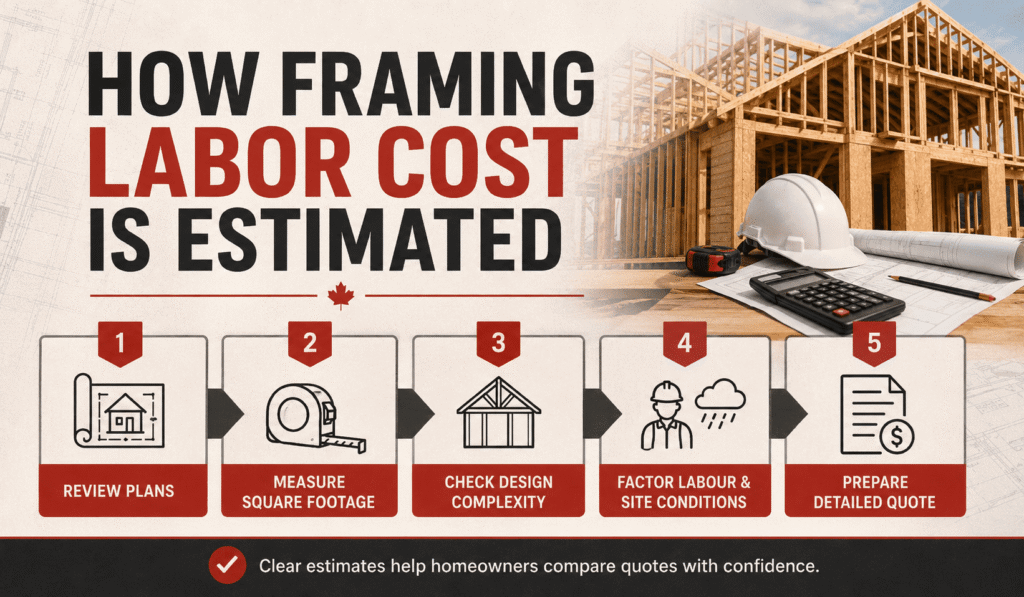
How to Reduce Framing Labor Cost Without Cutting Quality
Homeowners and builders can control framing labor cost by planning better, not by choosing the cheapest crew.
Good cost-control steps include:
- Finalize drawings before starting framing
- Avoid unnecessary layout changes during construction
- Choose a practical roof design
- Confirm beam and structural details early
- Keep the site clean and accessible
- Schedule material deliveries properly
- Hire experienced house framing contractors
- Compare detailed quotes, not just total prices
Cutting quality in framing is risky because framing affects the entire structure. Poor framing can lead to uneven walls, roof issues, window installation problems, drywall cracks, inspection delays, and costly rework.
When to Hire Professional Framing Contractors
Professional framing contractors should be hired when the project involves structural walls, additions, new homes, custom homes, commercial framing, or structural modifications.
Even small framing mistakes can affect load paths, building inspections, and the performance of the finished home.
A qualified framing contractor should understand:
- Structural drawings
- Local building practices
- Load-bearing walls
- Beam and header installation
- Roof and floor systems
- Site safety
- Coordination with builders and other trades
For homeowners in Calgary, choosing local framing contractors also helps because they understand Alberta weather, common home styles, local inspection expectations, and construction timelines.
Need House Framing Contractors in Calgary?
Woodzio Framing provides residential framing, custom home framing, commercial framing, interior framing, and other framing services for projects across Calgary and nearby areas.
The company focuses on accurate layouts, reliable framing crews, clean job sites, and strong coordination with builders, homeowners, and general contractors.
For homeowners planning a new build, addition, basement framing project, or structural change, working with experienced wood framing contractors can help keep the project organized from the first layout to the final inspection stage.
What Matters Most Before Comparing Framing Labor Cost
Framing labor cost depends on more than square footage. Materials, design complexity, labour availability, location, roof structure, site conditions, and project scope all influence the final price. In Canada, basic framing labour is commonly estimated by the square foot, but every project should receive a detailed quote based on drawings and real site conditions.
Wood framing remains the most common choice for Canadian residential construction because it is practical, flexible, and widely supported by skilled framing crews. Steel framing can be useful in certain projects, but it often involves different labour requirements and cost considerations.
FAQ’s
How much does framing labor cost per square foot in Canada?
Framing labor cost in Canada commonly ranges from about $4 to $10 per square foot for standard residential framing. Custom homes, complex rooflines, tall walls, structural beams, and difficult site conditions can increase the labour price.
Is framing labour cheaper than framing materials?
Framing labour can be lower than material costs on some projects, especially when lumber, sheathing, engineered beams, and trusses are included. However, complex designs can increase labour time and make labour a larger part of the framing budget.
Why do framing contractor quotes vary so much?
Quotes vary because contractors may include different scopes. One quote may be labour-only, while another may include materials, sheathing, roof framing, equipment, cleanup, or extra structural work. Homeowners should compare the details, not just the total price.
Does wood framing cost less than steel framing?
For most standard residential homes in Canada, wood framing is usually more affordable and easier to source. Steel framing may cost more upfront because it can require specialized labour, tools, fasteners, and engineering coordination.
How can homeowners reduce framing labor cost?
Homeowners can reduce unnecessary labour cost by finalizing drawings early, avoiding design changes, simplifying rooflines, preparing the site properly, and hiring an experienced framing contractor who works efficiently and accurately.