
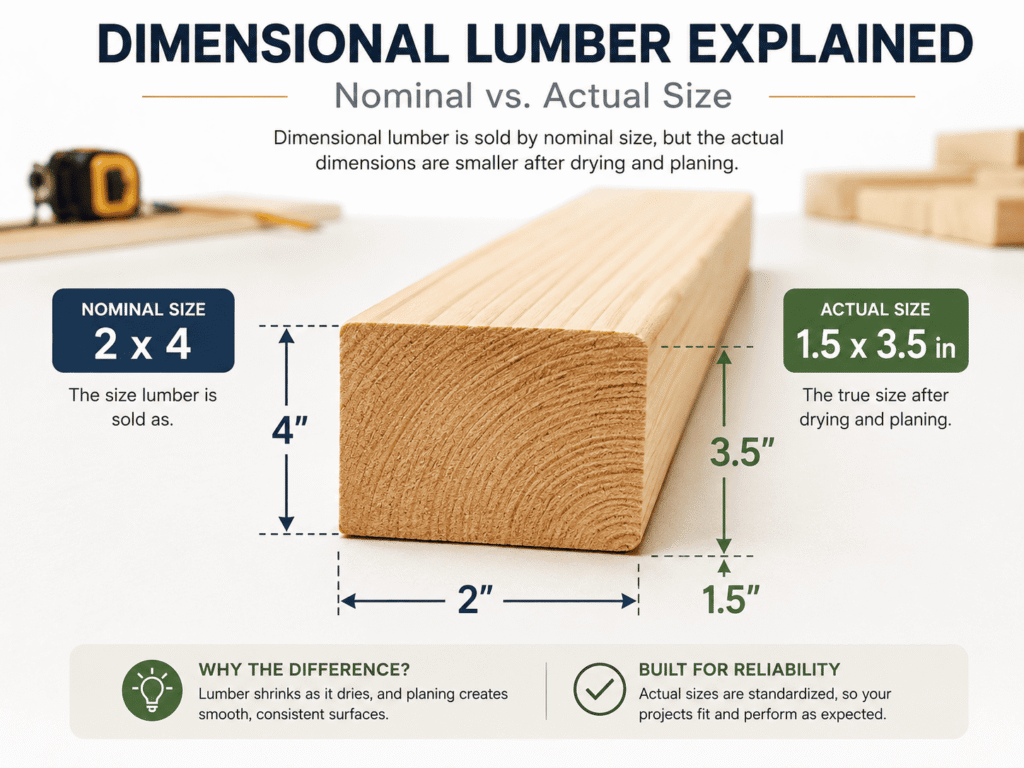
Dimensional lumber is solid wood manufactured in standardized thicknesses, widths and lengths for construction. Common examples include 2×4, 2×6 and 2×10 boards used in walls, floors, roofs, decks and other framing systems. Although these names appear to describe exact measurements, they are actually nominal sizes. A finished 2×4 usually measures approximately 1½ inches by 3½ inches.
Understanding the difference between nominal and actual lumber dimensions helps builders estimate materials, interpret construction drawings and avoid measurement errors. The grade, species, moisture condition and treatment of the lumber must also be considered before it is used in a structural application.
What Does Dimensional Lumber Mean?
Dimensional lumber, also called dimension lumber, is wood cut and processed into recognized construction sizes. Logs are initially sawn into boards before the wood is dried and surfaced to create smoother faces and more consistent measurements.
Dimensional lumber differs from live-edge slabs, random-width boards and rough-sawn wood. Those products may retain irregular measurements or unfinished surfaces, while standard construction lumber is intended for repeatable use in conventional building systems.
Nominal Size vs Actual Size
The nominal size is the recognized trade name of a board, such as 2×4 or 2×8. The actual size is the finished measurement after the wood has been dried and surfaced.
Freshly cut wood contains moisture. As it dries, its dimensions change slightly. Planing removes additional material to produce smoother, straighter and more uniform faces. These manufacturing processes explain why the final board is smaller than the size written on its label.
Common Dimensional Lumber Size Chart
| Nominal size | Actual size in inches | Approximate metric size |
|---|---|---|
| 1×4 | ¾ × 3½ | 19 × 89 mm |
| 1×6 | ¾ × 5½ | 19 × 140 mm |
| 2×4 | 1½ × 3½ | 38 × 89 mm |
| 2×6 | 1½ × 5½ | 38 × 140 mm |
| 2×8 | 1½ × 7¼ | 38 × 184 mm |
| 2×10 | 1½ × 9¼ | 38 × 235 mm |
| 2×12 | 1½ × 11¼ | 38 × 286 mm |
| 4×4 | 3½ × 3½ | 89 × 89 mm |
These measurements represent common finished sizes for surfaced lumber. Rough-sawn boards, custom-milled products and specialty timber may have different dimensions.
Why Is a 2×4 Smaller Than Its Nominal Size?
Historically, lumber dimensions were associated more closely with the rough size of a board before drying and surfacing. As manufacturing became more standardized, mills began producing smoother and more consistent finished lumber.
The familiar names remained in use even though the finished measurements became smaller. As a result, the term 2×4 now describes a recognized product category rather than an exact two-inch-by-four-inch board.
Standardized sizes make it easier to coordinate wall thicknesses, insulation, sheathing, openings and interior finishes. Actual dimensions also influence strength, stiffness and allowable span, so structural members must be selected according to approved plans, span tables or professional design requirements.
Common Types of Construction Lumber
Construction lumber can be classified by species group, structural grade, moisture condition and treatment. Each characteristic affects its strength, durability and suitable applications.
Spruce-Pine-Fir
Spruce-Pine-Fir, commonly marked as S-P-F, is widely used in Canadian wood-frame construction. This species group is relatively lightweight, easy to cut and compatible with common fasteners.
S-P-F lumber is frequently used for:
- Wall studs and plates
- Blocking and backing
- Roof framing
- Trusses
- General light-frame construction
Its suitability for a particular structural application still depends on its dimensions, grade and the requirements shown in the project plans.
Other Structural Species Groups
Douglas Fir-Larch and Hem-Fir are also used in structural construction. Douglas Fir-Larch may be selected where stiffness and strength properties suit the design, while Hem-Fir is used in various wall, floor and roof applications.
Regional availability varies, so contractors often select lumber based on both design requirements and products commonly stocked by local suppliers.
Softwood vs Hardwood
Most dimensional framing lumber is made from softwood. Softwood species are widely available, relatively easy to work with and suitable for conventional structural framing.
Hardwood can also be cut into standardized sizes, but it is more commonly used for flooring, furniture, cabinetry, trim and specialty woodworking. Hardwood is not automatically the best choice for structural framing simply because it may be denser.
Treated vs Untreated Lumber
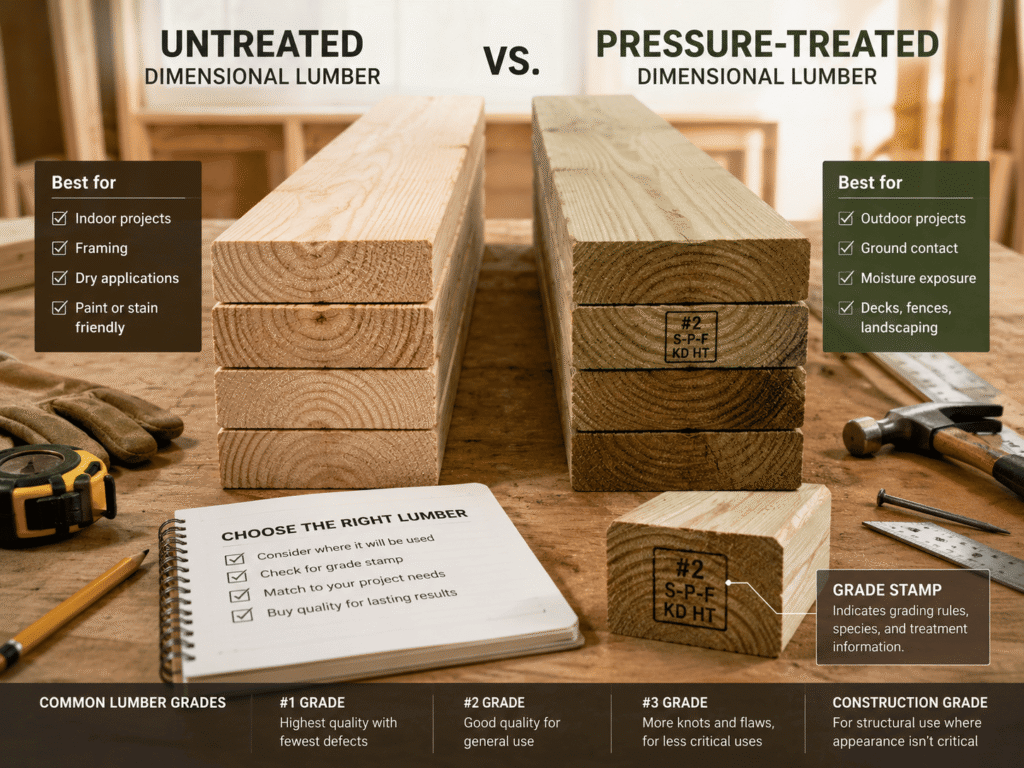
Untreated lumber is generally used in protected and dry areas, such as interior walls, enclosed floor systems and roof framing.
Pressure-treated lumber contains preservatives that improve resistance to decay, insects and moisture-related damage. It is commonly used where wood may be exposed to weather, soil or persistent dampness.
Typical applications include:
- Deck framing
- Exterior stairs
- Fences
- Outdoor platforms
- Ground-contact supports
- Moisture-exposed structural components
Treatment must match the expected exposure. Lumber intended only for above-ground use may not be appropriate for direct contact with soil or standing water.
Fasteners and metal connectors should also be compatible with the chemicals used in treated wood. When treated lumber is cut or sanded, suitable protective equipment and proper dust-control practices should be followed.
Understanding Structural Lumber Grades
Two pieces of lumber with the same nominal dimensions may not provide the same structural performance. Knots, splits, grain direction, checks, wane and other natural characteristics can affect strength.
Structural lumber is inspected and assigned a grade according to established grading rules. This grade helps designers and contractors determine whether the material is suitable for a particular use.
What Does a Lumber Grade Stamp Show?
A typical lumber grade stamp may identify:
- Structural grade
- Species or species group
- Mill identification
- Grading agency
- Moisture condition
- Applicable grading standard
The stamp provides more reliable information than appearance alone. A board that looks clean may still lack the classification required for a structural application.
Common Lumber Grades
Select Structural: A higher structural grade with tighter limitations on characteristics that may reduce strength.
No. 1 Grade: Used where relatively strong and consistent structural performance is required.
No. 2 Grade: Frequently specified for general framing, joists, rafters and other structural members when approved by the design.
Stud Grade: Intended mainly for vertical wall-stud applications.
Construction or Standard Grade: Used for general light framing where the structural requirements permit it.
Utility or Economy Grade: Usually better suited to temporary, limited or non-critical applications.
What Is Dimensional Lumber Used For?
The intended use of dimensional lumber depends on its size, grade, species and exposure conditions.
Wall Framing
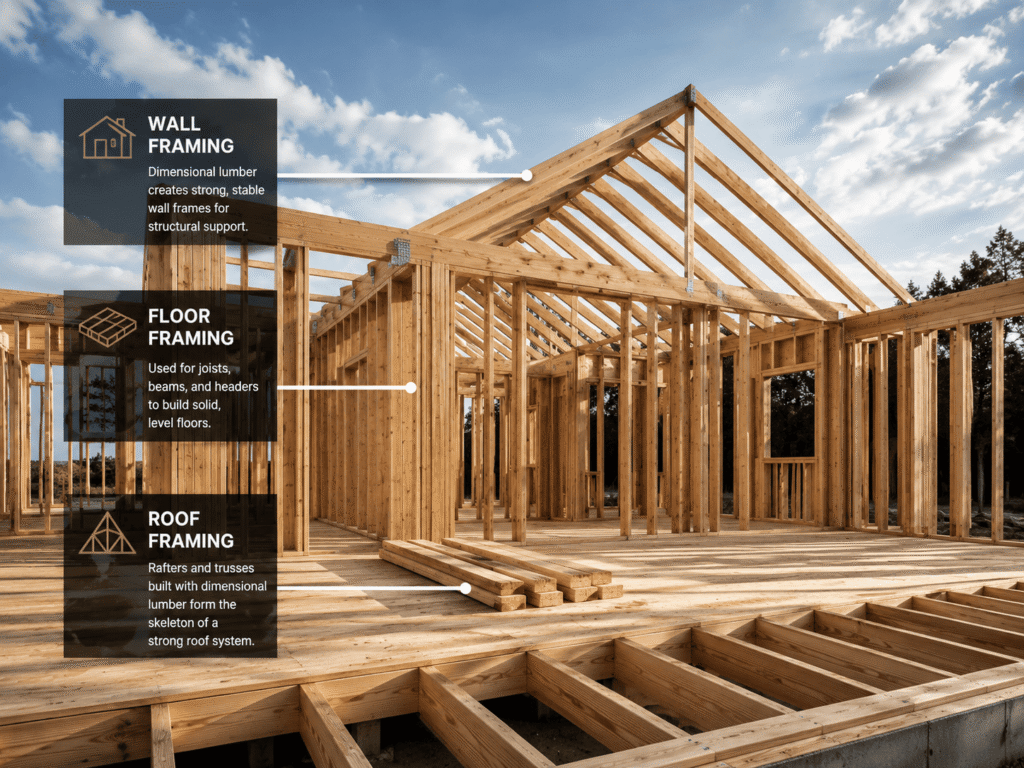
Nominal 2×4 and 2×6 boards are commonly used for studs, top plates, bottom plates, blocking and some headers.
The required wall depth may depend on structural loads, building height, insulation needs and the space needed for plumbing or mechanical systems. A 2×6 wall creates a deeper cavity than a 2×4 wall, but the correct assembly must follow the building design.
Floor Joists
Larger boards such as 2×8, 2×10 and 2×12 may be used in traditional floor systems.
Joist selection depends on more than depth. Span, spacing, species, grade, load and support conditions must also be evaluated. Engineered I-joists and floor trusses may be selected where longer spans or greater dimensional consistency are required.
Roof Framing
Dimensional lumber may be used for rafters, ceiling joists, ridge components and parts of prefabricated roof trusses.
Roof framing must account for span, slope, member spacing, wind and snow loads. These factors are especially important in areas where seasonal weather creates significant structural loading.
Decks and Exterior Structures
Properly specified treated lumber may be used for deck joists, beams, posts, stairs and other outdoor components.
Long-term performance also depends on drainage, ventilation, ground clearance, compatible connectors and corrosion-resistant fasteners.
Blocking and Bracing
Short pieces of framing lumber are often used for blocking, backing, bracing and support around openings or fixtures.
Although these components may appear minor, incorrect placement can affect stability and interfere with insulation, plumbing, electrical work, drywall and interior finishes.
What Lengths Does Dimensional Lumber Come In?
Dimensional lumber is commonly sold in standard lengths such as:
- 8 feet
- 10 feet
- 12 feet
- 14 feet
- 16 feet
Longer boards may also be available for specific sizes and structural applications. Availability depends on the species, grade, board dimensions and local supplier.
Builders normally select lengths according to wall height, span, transportation limitations and the amount of cutting waste. Choosing a suitable stock length can reduce unnecessary joints and improve material efficiency.
Dimensional Lumber Compared With Other Wood Products
Dimensional lumber is one of several wood-product categories used in construction.
Dimensional Lumber vs Rough-Sawn Lumber
Dimensional lumber is planed to consistent finished measurements. Rough-sawn lumber retains a more textured surface and may remain closer to its original sawn dimensions.
Rough-sawn wood is often selected for decorative beams, rustic features, restoration projects and agricultural structures. Surfaced lumber is usually more practical where accurate and repeatable measurements are required.
Dimensional Lumber vs Engineered Wood
Dimensional lumber is cut directly from solid logs. Engineered wood is manufactured by combining veneers, strands, fibres or smaller wood components.
Examples of engineered wood include:
- Laminated veneer lumber
- Wood I-joists
- Glued-laminated timber
- Structural composite lumber
- Roof trusses
- Open-web floor trusses
Engineered products may offer longer spans, improved dimensional stability and more predictable structural properties. Solid-sawn lumber remains practical for wall framing, blocking, bracing and many conventional building assemblies.
How to Choose and Store Framing Lumber
The correct nominal size is only one part of material selection. Each board should be inspected before installation.
Confirm the Grade Stamp
The grade, species group and moisture condition should match the project requirements.
Check Straightness
The board should be examined along its length for bowing, twisting, cupping or crooking. Severely distorted lumber can create uneven walls and make sheathing or drywall installation more difficult.
Inspect Knots and Damage
Large knots, deep splits, excessive wane and damaged edges may limit where a piece can be used. The permitted amount depends on the assigned grade and structural application.
Match Treatment to Exposure
Lumber used outdoors or in moisture-prone areas should carry treatment information suitable for the expected service conditions.
Store Lumber Correctly
Framing lumber should be:
- Raised above soil and standing water
- Supported evenly on a level base
- Protected from rain and snow
- Ventilated to prevent trapped moisture
- Organized by size and grade
- Inspected again before installation
A cover should protect the top of the stack without sealing damp wood completely. Uneven support can cause long boards to sag, while trapped moisture may contribute to staining, mould or movement.
Understanding Dimensional Lumber Before Building
Dimensional lumber is standardized solid wood used for walls, floors, roofs, decks and other framing systems. Its nominal name differs from its finished measurements, making actual size an important consideration during planning and construction.
The correct board should be selected according to its dimensions, species, structural grade, moisture condition, treatment and intended purpose. Understanding these factors helps prevent measurement errors, reduce material waste and support more accurate wood-frame construction.
Frequently Asked Questions
What is the actual size of a 2×4?
A common finished 2×4 measures approximately 1½ inches by 3½ inches, or 38 × 89 millimetres.
Why is dimensional lumber smaller than its stated size?
Drying and surfacing reduce the original rough dimensions. The familiar nominal name remains even though the finished board is smaller.
Is all dimensional lumber structural?
No. Standard dimensions alone do not make lumber suitable for structural work. Grade, species, condition and intended use must also be checked.
Is dimensional lumber always softwood?
Most framing lumber is made from softwood. Hardwood may be milled into standard sizes but is more commonly used for cabinetry, flooring, furniture and specialty work.
Can dimensional lumber be used outdoors?
It can be used outdoors when its treatment, species and installation details are appropriate for the expected moisture exposure.